
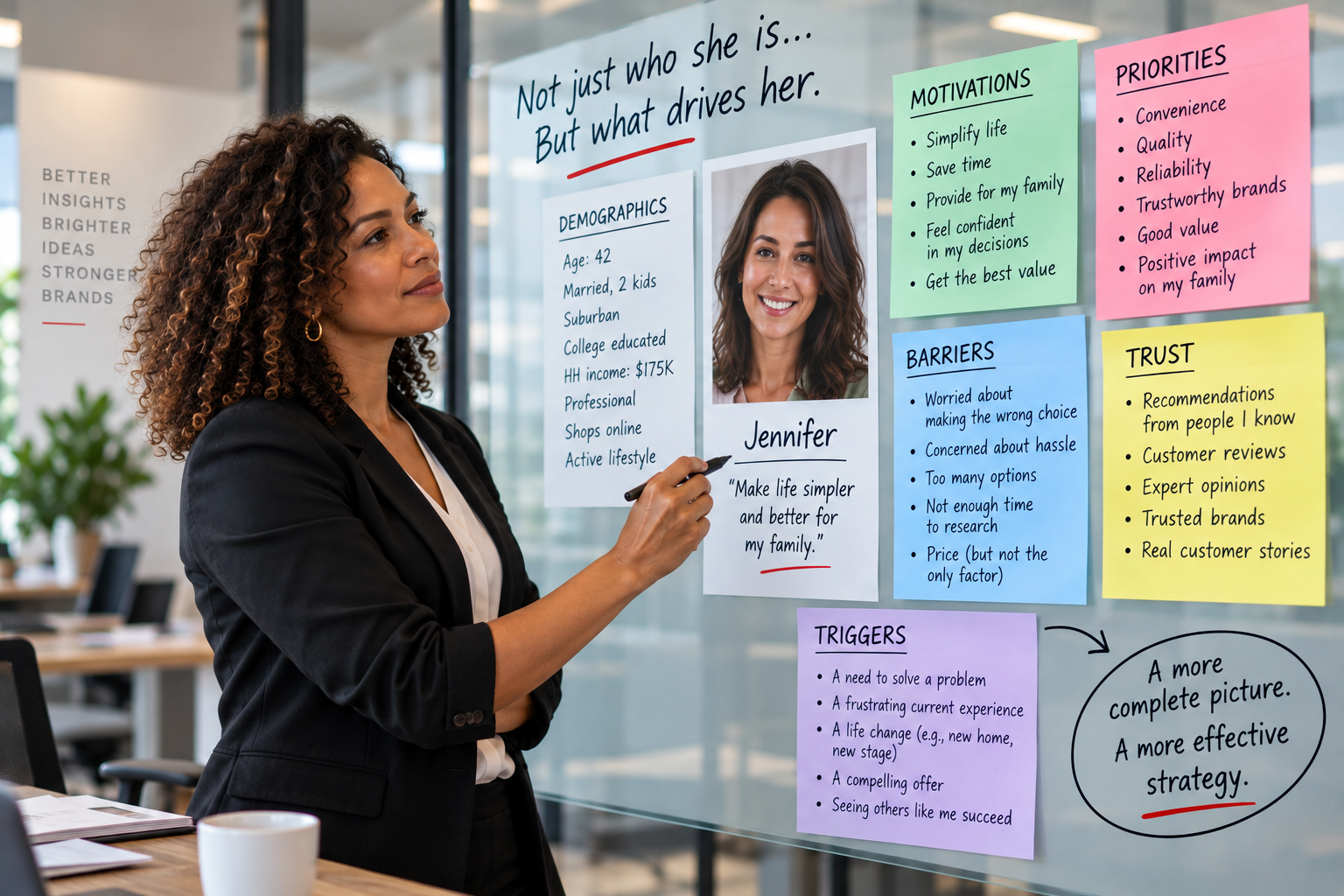
Beyond Personas.
Building customer profiles based on what really drives behavior.
Meet Jennifer.
She's 42, married, has two children and lives in an affluent suburb. She has a college degree, a household income of $175,000 and works in a professional occupation.
She shops online regularly, exercises three times a week and travels several times a year.
Sound familiar?
For decades, marketers have created customer personas using profiles much like this one. Give Jennifer a stock photo, a catchy label like "Busy Professional," add a few bullet points about her lifestyle, and you have something that looks remarkably like a customer.
There's just one problem. None of this tells us why Jennifer will — or won't — buy your product.
Traditional personas can help make an abstract target audience feel more tangible. But if they're built primarily around demographics and assumptions, they can create the appearance of customer understanding without providing much insight into what actually drives behavior.
The opportunity isn't necessarily to abandon personas. It's to make them much more useful.
The Problem With the Traditional Persona
Demographics matter. Age, income, education, geography, family status and other characteristics can help define markets, identify opportunities and determine where and how to reach an audience.
But people who look remarkably similar on a demographic profile can make very different decisions. Consider two 42-year-old working mothers with similar incomes, education levels and family structures.
One may prioritize convenience above almost everything else. She's willing to pay more if a product saves time and simplifies her life. The other may enjoy researching purchases extensively. She takes pride in making smart decisions and wants evidence that she's getting the best value.
Show both women the same marketing message and you may get two very different reactions. That's because demographics describe characteristics. Motivations help explain behavior.
From Customer Description to Customer Understanding
A more useful customer profile goes beyond describing who someone is and starts explaining how that person thinks. That means exploring questions such as:
What are they trying to accomplish? A customer isn't simply buying a product. They're usually trying to achieve an outcome — save time, feel confident, reduce risk, improve performance, demonstrate status, take care of someone, simplify a task or solve a problem.
What matters most to them? Price may be important. But so might quality, convenience, expertise, sustainability, reliability, innovation or social proof. Knowing which factors matter — and their relative importance — can fundamentally change your marketing strategy.
What worries them? Sometimes the most powerful driver of behavior isn't what customers want. It's what they're trying to avoid. Making a mistake. Wasting money. Choosing the wrong solution. Looking uninformed. Creating more work. Taking an unnecessary risk. Understanding those barriers can be just as valuable as understanding aspirations.
Who and what do they trust? An expert recommendation may be persuasive to one audience and nearly irrelevant to another. Some people trust professional authorities. Others trust customer reviews, friends, influencers, independent research or their own experience. Understanding where credibility comes from can help determine both the message and the messenger.
Attitudes Can Be More Revealing Than Attributes
Traditional segmentation often focuses on attributes: Age. Income. Geography. Education. Household composition.
Deeper customer intelligence adds attitudes: How do they feel about your category? How confident are they when making a purchase? Are they enthusiastic about innovation or skeptical of it? Do they see your product as an investment, a necessity, an indulgence or a commodity? Are they satisfied with their current solution? What would have to happen for them to switch?
Those attitudes can reveal differences that aren't visible in demographic data. And those differences can have enormous implications for marketing.
Build Profiles Around Decisions
One useful way to improve customer personas is to build them around the decisions you're actually trying to influence. Suppose you're developing a campaign for a new service.
A conventional persona might tell you: Jennifer, 42. Married, two children. Household income: $175K. College educated. Suburban homeowner. Heavy digital user.
A decision-oriented profile might add: Primary motivation: Wants to simplify a complicated task and save time. Key barrier: Concerned that switching providers will create more hassle than it's worth. Decision criteria: Reliability and convenience matter more than lowest price. Trust signals: Recommendations from people she knows and evidence of a proven track record. Trigger: A frustrating experience with her current provider makes her receptive to alternatives. Message opportunity: Demonstrate how easy it is to switch while reducing the perceived risk of making a change.
Now you have something a marketing team can actually use. The customer hasn't simply become more detailed. She's become more actionable.
Better Profiles Lead to Better Questions
This richer approach can also change the conversations happening inside an organization. Instead of debating whether Jennifer prefers blue or green — or inventing hobbies to make a persona feel more realistic — the team can focus on strategically relevant questions.
What problem are we solving for her? What is she worried about? What would make our solution more compelling? What evidence does she need? What might stop her from acting? What would cause her to switch?
Those questions connect customer understanding directly to marketing decisions. And that's ultimately what a useful persona should do.
Don't Confuse Detail With Insight
There's a temptation when creating personas to keep adding information. Favorite brands. Preferred social platforms. Hobbies. Car ownership. Media consumption. Shopping frequency.
Some of these details may be extremely relevant. Others may simply make the profile feel more complete. The test should be straightforward: Does knowing this help us make a better decision?
If the answer is no, the information may be interesting — but it isn't necessarily useful. A ten-page persona filled with facts isn't automatically better than a one-page profile centered on the handful of factors that genuinely drive customer behavior. More detail isn't the goal. Better understanding is.
Personas Should Be Discovered, Not Invented
Perhaps the biggest problem with some customer personas isn't their format. It's how they're created. Too often, personas are assembled through internal workshops where teams brainstorm what they believe their customers think, want and value.
That can be a useful starting hypothesis. But it shouldn't be mistaken for customer insight. The strongest customer profiles are grounded in reliable evidence — not simply internal assumptions about what customers probably think.
Research can validate some assumptions, challenge others and reveal motivations or barriers the organization hadn't considered. Sometimes the most valuable insight is discovering that the customer you thought you understood isn't quite the customer you actually have.
See the Person Behind the Profile
At Apertuur, we believe customer profiles become more powerful when they reveal more than the characteristics of an audience. They should help reveal the people within it.
Their motivations. Their attitudes. Their concerns. Their priorities. Their behaviors. And ultimately, the factors that move them toward — or away from — a decision.
Demographics still have an important role to play. So do behavioral data, transactional information and media habits. But the real opportunity comes from bringing those pieces together with a deeper understanding of why people behave the way they do.
Because a useful customer profile shouldn't just help you picture your customer. It should help you understand what to do next.